


Cloud computing security is a combination of controls, policies, and technologies used to protect environments, data, and applications deployed and maintained on the cloud. Cloud computing is the on-demand delivery of data storage and computing power.
It allows organizations to focus their resources on development and innovation while CSPs take care of setting up and scaling servers. It should be noted that cloud computing security is different from cloud-based security. Cloud-based security solutions generally come under security-as-a-service (SECaaS), offering centralized security services hosted on the cloud. They do not need dedicated resources in the company’s existing infrastructure.
The cloud essentially functions on the Internet, and cloud security refers to measures implemented to particularly address issues arising from cloud-based operations. When we access and store things on the cloud, we use remote servers with an Internet connection instead of local hardware. It equates to renting physical space in a storage unit. Cloud service providers (CSPs) take care of allotting and maintaining this physical space for your assets.
As per the 2020 Cloud Computing Study by IDG, 81% of organizations host at least one application or module of their infrastructure on the cloud. This is up by 8% in just two years. The reasons why organizations are increasingly moving to the cloud are quick deployment, low set-up costs, geographical flexibility, and, most importantly, scalability.
Without cloud computing in the picture, most enterprises rely on firewalls and endpoint device management for security. Having in-house infrastructure reduces security concerns for certain aspects of the system, such as data storage. This is reflected in the fact that most security attacks with on-premise architecture are malware-related, such as denial of service and sniffing attacks.
Cloud security is a part of cyber security that helps secure the data and resources in the cloud computing environment. Cloud security comprises compliance, procedures and technology required to secure the cloud assets. It differs from traditional cyber security as the real data is stored in virtual storage (cloud storage). Therefore, a complete understanding of cloud computing is essential to implementing an effective cloud security framework.
In most cases, the cloud service provider takes the responsibility of securing the data in the cloud platform. But it is also the responsibility of the companies to secure their online assets from internal breaches and cyber-
Software as a service (SaaS) Cloud security issues
- Absence of any visibility into what data is held within cloud applications
- Unable to monitor data whilst transiting from, or to, cloud applications
- Shortage of staff with the requisite security skills to manage cloud applications
- Threats and attacks, of an advanced nature, against the cloud application provider
- Unable to assess the security of the cloud application provider’s operations
- Unable to maintain regulatory compliance
- Lack of complete control over who can access sensitive data
- Data theft from a cloud application by a malicious actor
- Unable to prevent misuse of data or malicious insider theft
Infrastructure as a service (IaaS) Cloud security issues
- Inadequate visibility into what data is in the Cloud
- Lack of ability to monitor cloud workload systems and applications for vulnerabilities
- Insufficient staff members with the necessary skills to secure cloud infrastructure
- Advanced threats and attacks against cloud infrastructure
- Absence of consistent security controls over multi-
cloud and on- premises environments - Wide spread of an attack from one cloud workload to another
- Data theft from a cloud application by a malicious actor
- Lack of complete control over who can access sensitive data
- Unable to prevent misuse of data or malicious insider theft
Private Cloud security issues
- Inconsistent security controls spanning traditional and virtualized private cloud infrastructures
- Growing complexity of infrastructure needing more time-
effort for implementation and maintenance - Shortage of staff with skills such as virtual compute, network, storage, to manage security for a software-
defined data center - Advanced threats and attacks against cloud infrastructure
- Wide spread of an attack from one cloud workload to another
- Lack of complete visibility over security for a software-
defined data center, for example, virtual compute, network, storage - Data theft from a cloud application by a malicious actor
- Lack of complete control over who can access sensitive data
- Unable to prevent misuse of data or malicious insider theft

Depending on the cloud deployment model selected by organizations, and whether you opt for SaaS, IaaS, or PaaS cloud services, companies may face or at least need to consider, several issues when migrating to the Cloud.
Below is highlighted the most likely type of issues faced by organizations as part of their Cloud migration. Several issues faced are similar in nature to the issues faced with traditional computing environments.


With the surge in cloud infrastructure adoption for business operations, security challenges are also increasing. The main reason for security concerns is the lack of understanding in the shared responsibility model between the CSP (cloud service provider) and the organization. The common security challenges that affect the cloud environment are listed below.

The survey report of IDC, a global intelligence firm, suggests that data breach is at the top of the list of cloud security threats. Cloud storage involves high-
Preventive Measures
- Using encryption technology like SSL Certificate can reduce the impact of data breaches and secure critical information.
- To control user access, organizations can use the principle of least privilege. For example, limiting access to critical resources helps mitigate the possibility of a data breach.
- The layer of security can be added through multi-
factor authentication, eliminating unauthorized user access. - Cyber hygiene helps to reduce data breach instances where proper removal and disposal of unused data can prevent data leaks.


As the admin's can operate the functions of the cloud servers over the network, there is a lack of visibility in the server management. As a result, it could lose control over the tools and resources, leading to security issues. The lack of visibility can create challenges such as employees using unauthorized applications and approved applications for malicious purposes. It creates a lack of governance that will attract more cyber security threats.
Preventive Measures
- A frequent risk assessment will help keep the cloud server control in check.
- Developing a framework for data access can create visibility in the cloud environment.
- Establishing and implementing regulatory compliance for cloud usage.
- Conducting an awareness program for access control, improving cloud visibility.


The exposure of credential information of the critical cloud account results in cloud hijacking. In this case, the hijacked account can carry out cyber-
Preventive Measures
- Using Identity and Access Management controls to mitigate the possibility of suspicious account access.
- Maintaining critical and non-
critical resources in a different environment limits access to critical resources. - Monitor the user behavior to spot malicious activities in the early stage.
- Create employee awareness regarding account hijacking prevention.

Cloud misconfiguration is one of the top reasons for vulnerability threats. In most cases, the misconfigurations are human errors like using the default settings, reusing the passwords, etc. The other reasons include excessive permissions, unused accounts, excess sharing, disabling standard security controls and more. However, the misconfiguration could lead to a cyber-
Preventive Measures
- Tracking and monitoring the data access management for suspicious activity. It helps in detecting the threats by tracking the changes in configurations.
- Creating a benchmark configuration and conducting a regular audit to check the configuration settings.
- Limiting the access to the authorized persons based on the need for resources for work. Frequent Revaluation of the designation and access permission of the employees.
The threat is caused by the organization’s insiders, including employees, former employees, partners, and contractors who have access to sensitive data or privileged accounts. The insider threat could have a huge consequence on the business, even if it occurs accidentally. Therefore, it is the organization’s responsibility to take necessary measures to prevent insider threats from causing data leaks and security breaches in the cloud.
Preventive Measures
- Proper implementation of access control eliminates the abuse of privileged access.
- Identify and separate the critical resources secured with access control and authentication. Track the authorized personnel and monitor the data access to prioritize the critical resources. It helps to identify the threats beforehand.
- Split the privileged accounts from normal accounts for tracking purposes.
- Create a baseline access behavior and mandate the employees to adhere to the baseline.


The UIs (User interface) and APIs (Application Programming Interface) are the most vulnerable part of the cloud infrastructure. Because of that, this acts as the communication platform between the customer and the CSP (Cloud Service Provider). But the security of the UI and API comes under the service provider’s responsibility. Where the security is integrated by the cloud provider that the user will monitor and manage, insecure UI and API will expose user account details and admin control.
Preventive Measures
- Using APIs designed according to the industrial standards with the visible framework.
- Limiting access to overriding tools allows the system, network, vulnerability management, and applications control changes.
- Follow proper API hygiene.

One of the primary reasons for all security challenges in cloud computing is the lack of cloud security experts. A sudden spike in the adoption of cloud computing for business has created a great demand for cloud experts. The cloud experts differ from the regular IT, as they require extensive knowledge in cloud computing to secure the cloud infrastructure and data. But there is a huge demand for cloud security experts resulting in poor maintenance of the cloud environment leading to vulnerability exposure. Cybercriminals can use it to perform a cyber-
Mitigation
- The organizations can use third-
party MSSP (Managed Security Service Provider) or cloud management company to handle the cloud infrastructure security. The advantage of leveraging the cloud security company is that it is equipped with security experts and tools to manage cloud security. - The other way is to train the security professionals with the knowledge of cloud computing and the security tools and techniques to secure the cloud environment. The prolonged training with the right guidance will help the experts master cloud security.


Penetration is the process of inducing a simulated cyber-attack over the private network to find out the vulnerabilities present in the IT infrastructure. It is also a kind of ethical hacking, where the penetration test is pre-planned, and the outcome is analyzed to identify the vulnerabilities and fix them. With the help of advanced tools and techniques, one can also use it to check the implementation of the security framework in an organization.

The penetration test done in the cloud infrastructure is known as cloud penetration testing. The penetration test works with the shared responsibility of the CSP and the customer. There is a major difference between conducting a private and a cloud network penetration test. The surprise test can be conducted in the case of a private while in the cloud framework; a prior notice to the cloud service provider is essential to prevent any unforeseen impacts during the test.

The penetration test plays a key role in maintaining the security in the cloud infrastructure. The pen-

- Black box penetration test: In this method, the penetration testers do not have access or knowledge of the organization’s cloud infrastructure.
- Grey box penetration test: Here, the penetration testers will have limited knowledge of the cloud framework and are granted restricted admin access based on the requirement.
- White box penetration test: The penetration testers are granted complete access to the cloud network, including the root-
level access.
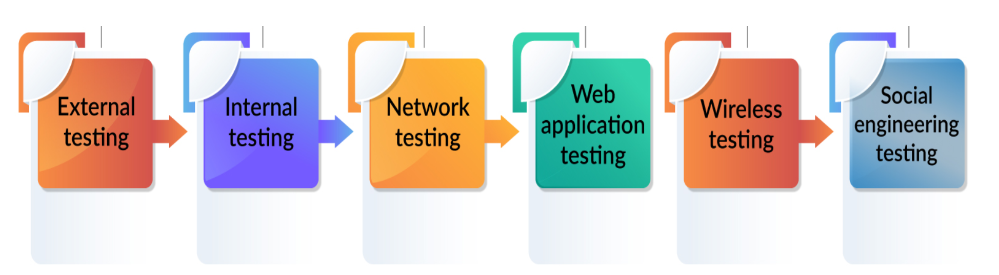


The next phase is to act upon the vulnerability report submitted by the IT security team. Detection without fixing is useless, so it is essential to identify the vulnerabilities. The remedies can be based on the nature of the vulnerabilities. Some can be rectified with minor coding, while others need specific tools and techniques. But, fixing the vulnerabilities can prevent the organization from the negative consequences of the unforeseen cyber-
Organizations that collect personally identifiable information (PII), including those in retail, healthcare, and financial services, face strict regulations when it comes to customer privacy and data security. Some businesses in certain geographic locations — or businesses that store data in particular regions — may have special compliance requirements from local or state governments as well.
Before establishing a new cloud computing service, your organization should review its particular compliance requirements and make sure that a service provider will meet your data security needs. Staying compliant is a top cloud security priority. Governing bodies will hold your business responsible for any regulatory breaches, even if the security problem originated with the cloud provider.


Unlike private data centers, where the enterprise is completely responsible for security, the public cloud adds complexity, and at times a little confusion. The cloud customer is ultimately responsible for cloud security, but the cloud services provider takes on some security responsibilities, a structure known as the shared responsibility model. Leading IaaS and PaaS providers, such as AWS and Microsoft Azure, provide documentation to define roles in various deployment situations. Enterprises evaluating cloud vendors should check these common security rules to minimize miscommunication and misconceptions, which can lead to lax security controls and events going unnoticed. But as long as the customer does their part, like implementing encryption and configuring connections and settings properly, data will generally be secure.

In addition to clarifying shared responsibilities, organizations should ask their public cloud vendors detailed questions about the security measures and processes they have in place. It’s easy to assume that the leading vendors have security handled, and in some cases they do, but security methods and procedures can vary significantly from one vendor to the next.

Unauthorized access is a major concern with public cloud security. Organizations should consider building comprehensive identity and access management (IAM) systems based on the following principles to minimize risk:
- Organizations should be able to design and enforce access controls based on the concepts of least privilege and zero trust. This entails restricting user access to only what is required for their tasks and approaching all access requests with caution. Privileged access management (PAM) can help secure access for the most sensitive accounts.
- Implement IAM policies that offer permissions based on role-
based access control (RBAC). This guarantees that users’ access is provided based on their unique positions within the company, decreasing the possibility of unwanted access. - Implement multi-
factor authentication (MFA) to increase security. Even if hostile actors get credentials like usernames and passwords, MFA provides an additional layer of security by demanding additional verification, such as biometric scans or SMS codes. - Consider IAM solutions that can operate across private data centers and cloud deployments. This streamlines end-
user authentication and allows for uniform policy enforcement across all IT environments.

To prevent hackers from obtaining access credentials for cloud accounts and services, firms must train all employees on how to identify and respond to cybersecurity risks.
- Conduct thorough cybersecurity awareness training for all staff, addressing issues such as:
- Identifying cybersecurity threats
- Creating strong passwords
- Recognizing social engineering attacks
- Advanced topics like risk management
- Stress the potential risks of shadow IT, which occurs when employees use unapproved tools and applications, resulting in hidden vulnerabilities.
- Provide specialized training for security personnel to keep them up to date on emerging threats and countermeasures.
- Encourage responsibility by having regular talks about security practices, such as:
- Setting security standards for all staff members
- Discussing issues like data privacy, password management, and physical premises security
- Encouraging open discourse regarding the significance of security rules and regulations

All organizations should have written guidelines that specify who can use cloud services, how they can use them, and which data can be stored in the cloud. They also need to lay out the specific security technologies that employees must use to protect data and applications in the cloud.

The use of a cloud service increases the requirement for effective endpoint security, as endpoints often connect directly to the cloud. New cloud projects provide a chance to reexamine security techniques and respond to new threats.

Encryption is a key part of any cloud security strategy. Not only should organizations encrypt any data in a public cloud storage service, but they should also ensure that data is encrypted during transit — when it may be most vulnerable to attacks.
Some cloud computing providers offer encryption and key management services. Some third-

Intrusion detection and prevention systems (IDPS) are among the most effective security tools on the market. They monitor, analyze, and respond to network traffic, either as a standalone solution or part of another tool that helps secure a network like a firewall.


Whether an organization partners with an outside security firm or keeps security functions in-
- Penetration Tests
Examine the reliability of present cloud security solutions.
Identify vulnerabilities that might put data and applications at risk.
- Vulnerability Scans
Use cloud vulnerability scanners to detect misconfigurations and other flaws.
Enhance the security posture of the cloud environment.
- Regular Security Audits
Assess all security vendors and controls to determine their capabilities.
Make sure they follow agreed-
- Access Log Audits
Ensure that only authorized individuals have access to sensitive data and cloud apps.
Improve access control and data security measures.

This is actually one of the most effective cloud security options available today. Organizations should enable logging in their cloud services — and take it a step further by ingesting that data into a security information and event management (SIEM) system for centralized monitoring and response. Logging helps system administrators and security teams monitor user activity and detect unapproved modifications and activity, a process that would be impossible to accomplish manually. In the event that an attacker gains access and makes changes, thorough logs offer a clear record of their actions, and a SIEM tool would allow for quick remediation to limit damage.
Effective logging is also important for dealing with misconfigurations because it enables tracking of changes that can lead to vulnerabilities and allows for preventive steps. It also assists in detecting people with excessive access rights, allowing for changes to be made to reduce possible dangers.

It is essential not just to log misconfiguration data, but also to take proactive steps to reduce misconfigurations in storage buckets, APIs, connections, open ports, permissions, encryption and more. Some cloud services provide extensive rights by default, sometimes even to external users, posing serious security vulnerabilities if not restricted properly; default public settings for AWS S3 buckets is one such example.
Misconfigurations provide chances for malicious actors to:
- Steal from cloud buckets
- Move laterally through the storage infrastructure if they obtain the right credentials
Improper account permissions might allow attackers who steal credentials to gain administrator access, resulting in additional data breaches and possibly cloud-
- Personally configure each bucket or groups of buckets
- Collaborate with development teams to ensure that web cloud address setups are correct
- Ensure that the default access permissions are never used
- Determine the user access levels that are required (view-
only or editing rights) and configure each bucket accordingly
The first phase in conducting a penetration test is to evaluate the current cloud environment to identify the tested areas. Before starting a pen test, it is essential to spot the critical assets that could be an easy target for attackers. Without understanding the cloud structure, conducting a pen test will be a disaster that could create a new vulnerability. Proper evaluation of shared responsibility is also important for a successful pen test.
The organization should coordinate with the cloud provider to carve out the cloud security area under the organization’s responsibility. The company should give the service provider before protecting the other customers sharing the cloud platform from the simulated cyber-

The next phase is to create a plan to conduct the penetrating test. As the pen test involves many stakeholders, it is essential to consider all the factors while planning the test. Even though the planning varies with each tester and the organization, some common steps are followed.
- Check with the cloud provider compliance to determine the types of tests permitted along with the allowed tools and techniques.
- Finalize the endpoints of the cloud, such as UI (user interface), APIs, and networks to be included in the testing.
- After confirming the test type, method, tools and landscape, the last step is to get approval from all the stakeholders such as CSP, clients, partners, etc.

After completing the planning phase, the testing team can execute the simulated cyber-


The simulation test will expose the vulnerabilities present in all the layers of security. It is the responsibility of the testing to verify the vulnerabilities to eliminate false alarms. Once the verification is complete, the next step is to prepare a detailed report on the identified vulnerabilities. The impact of the penetration test lies in the preparation of a vulnerability report so that it can be presented to the stakeholders. Without reporting the vulnerabilities, the pen test will waste time and resources.





All Trademarks and Registered Trademarks are the property of their respective Owners.
2005 – 2024 Darwin & Associates IT, All rights Reserved


- Computer Network
- Data Recovery Services
- IT Business and Services
- IT Support Services
- On Site Support
- Remote Desktop Assistance
- Cloud Computing
- Information Security
Cloud Computing Value Proposition
- IT management simplification
- Operation and maintenance cost reduction
- Business mode innovation
- Low cost outsourcing hosting
- High service quality outsourcing hosting


Multi-
There are key differences between hybrid cloud security and multi-

Multi-
- Centralized management, including dashboards, reporting, and logging to assist with governance and troubleshooting across otherwise disparate and loosely-
connected environments. - Core services, such as networking, segmentation, service insertion, and traffic steering.
- Advanced services, such as load balancing, content delivery network (CDN), firewall, web application firewall (WAF), and Zero Trust Network Access (ZTNA).
- Identity and access management (IAM), which controls the access of users and applications to cloud resources. IAM policies and procedures should be implemented across all cloud providers to ensure consistent security practices.
- Data protection, which includes encryption of data at rest and in transit, as well as backup and disaster recovery plans to ensure the availability of data in the event of an outage.
- Network security, which is critical in a multi-
cloud environment as data and applications are spread across different cloud providers. This involves implementing secure network connections and protocols to protect data in transit.

- API management, which helps secure apps and APIs scattered across multiple cloud architectures to deliver responsive and reliable user experiences.
- Compliance and governance policies, which should be implemented across all cloud services to ensure that the organization meets regulatory requirements and industry standards.
- Threat detection and response capabilities, which aim to improve security response by implementing controls across different cloud environments in an as-
a- service model for more efficient detection and remediation.
Securing a multi-
- Use a centralized security management platform, which helps organizations monitor and manage security across multiple cloud providers. The platform should provide a single, holistic view of security across all clouds and enable automated security controls and policy enforcement.
- Implement consistent security practices and policies across all cloud providers, to ensure that there are no security gaps. This includes IAM policies and procedures, network security controls, web app and API protection, data protection measures, compliance and governance policies, and threat detection and response capabilities.
- Implement comprehensive protection with consistent security policies, to protect complex environments that include a mix of legacy and modern apps, multiple clouds, and the data center.
The following tips and best practices can help organizations maximize the benefits and minimize the risks of the multi-
- Understand the shared responsibility model. Different cloud providers may take varying levels of responsibility when it comes to security, and the shared responsibility model states that while cloud providers are responsible for securing their service infrastructure, customers are largely responsible for securing their data and applications within the cloud environment. It is important to understand the division of accountability between each cloud provider and the customer, and to implement additional security measures as necessary to ensure comprehensive security is in place across all cloud environments. For example, while major public cloud providers offer protection against volumetric denial-
of- service (DDoS) attacks, security at the application and API layer is generally insufficient to mitigate attacks from sophisticated cybercriminals that use vulnerability exploits and business logic abuse to compromise customer accounts and exfiltrate sensitive data.
- Implement a comprehensive security policy. An end-
to- end security policy should be implemented across data centers and all cloud environments, which includes encryption, access control, and L7 (application) security. Policies should be regularly updated and reviewed to ensure that they reflect current best practices and compliance requirements, and automated protections that leverage telemetry, behavioral analytics, and machine learning should be employed to improve efficacy and remediation.
- Maintain visibility and control. Centralized monitoring and management tools are essential for effective security management as they provide real-
time visibility into all cloud environments and enable quick responses to security incidents.
- Regularly audit and test security measures. Identify vulnerabilities and ensure that security measures are effective by regularly auditing and testing security measures, including regular vulnerability assessments, penetration testing, and security audits. Vulnerabilities at both the infrastructure and application layer need to be considered.
A multi-
Because multi-


Multi-
- Identity and access management (IAM) solutions. These solutions manage and authenticate users' access to cloud resources and applications across multiple cloud platforms.
- Cloud security posture management (CSPM) solutions. CSPM solutions provide real-
time monitoring and compliance checks of cloud infrastructure configurations to identify and remediate security risks. - Data loss prevention (DLP) solutions. DLP solutions prevent sensitive data from leaving the organization's network, including data stored in the cloud.
- Network security solutions. These solutions provide secure connectivity between cloud environments and on-
premises infrastructure, ensuring secure data transfer among them. - Threat intelligence solutions. These solutions monitor and analyze potential cyber threats across multiple cloud platforms to provide insights into emerging security threats.
- Security information and event management (SIEM) solutions. SIEM solutions provide a centralized view of security events across multiple cloud platforms and analyze security incidents in real-
time. - Cloud access security brokers (CASBs). CASBs enforce security policies between cloud platforms and users, provide visibility and control over cloud-
based data, and manage data protection and compliance. - Advanced services, which augment cloud-
native networking and security with highly effective, specialized traffic management and security. These services include load balancing, content delivery networks (CDN), firewalls, web application firewalls (WAFs), API gateways, and Zero Trust Network Access (ZTNA) solutions.
When selecting a multi-
- A multi-
cloud security solution should integrate with multiple cloud platforms as well as with on- premises data centers and private clouds, and provide a consistent security framework across the entire digital fabric, with real- time monitoring and mitigation to quickly remediate security incidents. In addition, the solution should automate security tasks to reduce the workload on security teams and minimize the risk of human error. - Compliance is an important factor, and the solution should meet compliance requirements such as GDPR, HIPAA, and PCI-
DSS. The solution should include advanced analytics capabilities that can identify threats and provide actionable insights and future- proof the architecture in order to accommodate the organization's growth.

Compliance automation tools
- Handles compliance tasks automatically
- Create and manage documents, policies, and protocols
- It brings all your public cloud apps together in one dashboard so you can see the progress all at once
- Sends you alerts if anything unusual happens in your cloud apps
Also, these tools often come with other features like risk assessment, policy management, handling training, keeping track of what’s been done, and helping with audits.
Basic key areas of multi cloud security are identity, access, and visibility. These are the building blocks and a comprehensive approach for keeping your data safe in the cloud.
Multicloud security related assets can be secured by several best practices outlined by industry experts. However, the most important one is setting up continuous monitoring, as it gives a 360-
| IT Services Repairs |
| IT Services Maintenance |
| Cloud Computing Security |
| AI and RPA |
| Cyber Security & Data Protect |