


In the simplest terms, RPA is an intelligent automation solution that allows businesses to create a virtual software robot workforce that performs repetitive tasks just as a human would, freeing human employees from mundane, repetitive work. Think about manually transferring data from one software application to another a mind-numbing daily need that is rife with opportunity for errors.
RPA enables businesses to create distinct virtual workforces that drive speed, agility, and efficiency and can take over those repetitive tasks. But the potential for RPA is greater than just one task, RPA stands out for its ability to positively impact outcomes business-wide by providing efficient ways to carry out processes across the organization, resulting in significant ROI.

RPA is a virtual workforce comprised of software robots that can execute business tasks in and across applications, becoming an integral part of a business’s workforce. The virtual workforce is managed just as any other team in the organization and can operate in the background without human intervention or interact with people to complete tasks. The robot’s complete business processes, just as a person would, but in less time, with greater accuracy, and at a fraction of the cost. In fact, one RPA robot can do the work of 3 to 5 full time employees because the robots can work 24/7/365.
RPA is used for automating and optimizing repetitive, time-
According to the Institute for Robotic Process Automation and Artificial Intelligence (IRPAAI), almost any organization that has many different, complicated systems that need to mesh together is a good candidate for RPA. In fact, across nearly every industry – finance, insurance, healthcare, legal, manufacturing, retail, banking and utilities, and others – RPA is used to create virtual workforces to automate burdensome, high volume, and time-


Robotic Process Automation is a software robot used by many businesses today. It is widely applied in many fields such as insurance, customer care, etc. This smart solution brings us many benefits, contributing to solving the difficulties that businesses are facing. In addition to the good aspects of RPA, it also has some disadvantages that negatively affect your automation process.
- Attrition is understood as a centralized resource for businesses. However, Robotic Process Automation can effectively solve the work in the automated system of the enterprise. But it cannot replace humans completely.
For tasks with fixed logic, it makes perfect sense to use RPA. As the workload increases, we can add more bots to take care of the work. Businesses will not have to hire additional staff to handle it. That will have a significant impact on some office staff.
Tasks such as data entry and labeling are often simple and do not require a high level of skill to complete. Therefore, Software Robots will replace humans to solve them better and faster. Accordingly, there will be a large number of workers facing job loss.
- Srawing technology As workloads increase, businesses will need more bots to perform more tasks. They run the risk of creating a collection of bots that are cumbersome and unwieldy if not properly managed. So, the companies will have to spend a lot of money to manage and maintain the bots.
Therefore, you should consider carefully before increasing the number of bots. Enterprises should have a clear management system to better control RPA’s operational processes. Don’t let a technology solution become a burden on your company. Work on quality, not quantity.
- Added complexity One of the prominent disadvantages of RPA is Added complexity. However, RPA makes it easy for businesses to change business processes. It makes it easier for them to make changes step-
by- step rather than systematically updating the software. If something goes wrong, RPA makes it difficult to fix the problem. Because it is a process, when a step is bad, it will take a lot of time to heal. - Magnification of problematic processes It can be said that the Magnification of complex processes is the defect with the biggest consequences of RPA. It can disrupt your entire automated process system, causing a variety of errors. The main reason is that businesses do not carefully consider the process before putting it into operation.
When businesses do not test and optimize processes thoroughly before automating them, there is a risk of automated processes having problems. This will lead to errors in succession. The failure of such a system will amplify the RPA’s mistakes and make them more difficult to control. More importantly, it affects work productivity, and aggregated data will not be accurate. In addition, the carelessness of businesses will cost them a great deal to remedy the consequences.
- Thwarted transformation Executives see RPA as a software assistant in a certain department in a large process. That will help optimize the process, get more benefits than limitations. Leaders want software robots to support their digitalization goals. Businesses must have specific strategic plans, prioritizing their automation projects. At the same time, they must understand those projects in order to make an accurate judgment of how well they fit with their overarching strategic vision.
- Lack of creativity In a way, we will see the lack of creativity in RPA. It can only understand programming languages, not humans. Therefore, in some jobs, RPA will be somewhat limited compared to other technologies. But overall, Robotic Process Automation is still doing its job well. To scale up for RPA, we should combine with other technologies such as process Mining, BPM, …

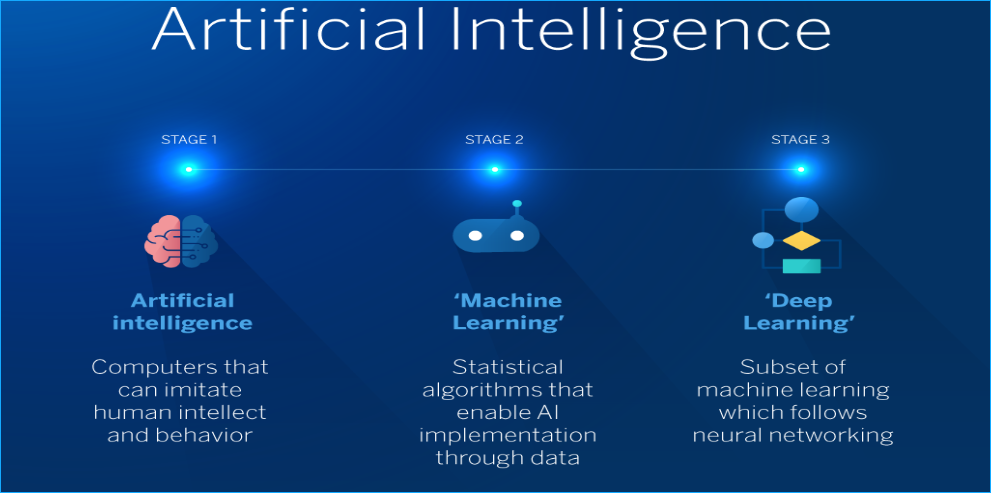


Artificial Intelligence can be broadly divided into two categories: AI based on capability and AI based on functionality.
Once we achieve Artificial General Intelligence, AI systems would rapidly be able to improve their capabilities and advance into realms that we might not even have dreamed of. While the gap between AGI and ASI would be relatively narrow (some say as little as a nanosecond, because that’s how fast Artificial Intelligence would learn) the long journey ahead of us towards AGI itself makes this seem like a concept that lies far into the future.
Artificial intelligence (AI) refers to the simulation or approximation of human intelligence in machines.
The goals of artificial intelligence include computer-
AI is being used today across different industries from finance to healthcare.
Some critics fear that the extensive use of advanced AI can have a negative effect on society.

UiPath is on a mission to uplevel knowledge work so more people can work more creatively, collaboratively, and strategically. The AI-

IBM’s market-
Software robots, or bots, can act on AI insights to complete tasks with no lag time and enable you to achieve digital transformation.

By driving business agility and productivity, RPA benefits the entire organization from data entry to sales efficiency. Some of the benefits of robotic process automation are:
- Greater business flexibility: Scale your virtual workforce quickly and easily. RPA allows for rapid change response and quick deployment when business needs arise.
- Improved employee satisfaction: Employees who would otherwise spend a large amount of time on rote, mundane, and repetitive tasks can use their skills to accomplish more challenging and business critical work.
- Increased cost savings: RPA saves costs by reducing valuable time spent by employees on mundane, repetitive tasks, and decreasing FTE workforce needs. And by improving accuracy, the bots eliminate time and cost-
intensive corrections and re- work. - Quick scalability: RPA operations can be scaled up quickly and easily. Users can add, change, or expand automation processes as needed without incurring downtime.
- Increased accuracy: Eliminate human oversight by assigning to robots’ error-
prone processes such as procure- to- pay, quote- to- cash, and claims processing. By reducing how often employees input data manually, you decrease the risk of human error and improve accuracy. Fewer mistakes mean happier customers. - Increased customer satisfaction: For customer service, automating the repetitive tasks that consume representatives’ attention, empowers them to get more done in less time – so they can minimize their average handling time and offer more personalized service. Better service experiences mean happier customers.
- Improved productivity: Execute unlimited processes with a single robot, including during peak periods. Virtual robots work 24/7, non-
stop to complete more tasks in less time, and can do the work of 3 to 5 full time employees. - Decreased Operational Costs: Decrease in-
house or outsourced workforce and training costs, and save valuable time by offloading mundane, repetitive tasks to virtual robots, that work 24/7. - Improved speed and efficiency: Virtual robots work 24/7/365 without breaks and at digital speeds. A task that may have previously involved many people and hours of time using fragmented processes now only requires one person to set up the RPA bots which work quickly.
- We should distribute a reasonable amount of RPA. To avoid an explosion in numbers that leads to loss of control of RPA bots, prepare a clear, tight bot management system to operate the automation process at its best.
- Businesses should have a clear division of work for each department. For logical repetitive tasks, we should use RPA to solve them. But you need to avoid overdoing it to avoid losing control. Add manual labor to these jobs to balance the benefits and risks. This also helps companies with automated process systems operate most efficiently. At the same time, it also creates jobs for some low-
skilled departments.
- Test the process thoroughly before putting it into automation because carelessness will have extremely serious consequences for businesses. In addition, reviewing the process before operation also helps to minimize errors and improve labor productivity.
- We should use some more technology to scratch our automation process. Because that combination will help RPA work more effectively, avoiding unnecessary risks.





Artificial intelligence (AI) is the intelligence of a machine or computer that enables it to imitate or mimic human capabilities.
AI uses multiple technologies that equip machines to sense, comprehend, plan, act, and learn with human-like levels of intelligence. Fundamentally, AI systems perceive environments, recognize objects, contribute to decision making, solve complex problems, learn from past experiences, and imitate patterns. These abilities are combined to accomplish tasks like driving a car or recognizing faces to unlock device screens.
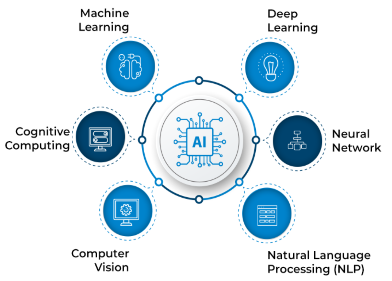
The AI landscape spreads across a constellation of technologies such as machine learning, natural language processing, computer vision, and others. Such cutting-edge technologies allow computer systems to understand human language, learn from examples, and make predictions.
Although each technology is evolving independently, when applied in combination with other technologies, data, analytics, and automation, it can revolutionize businesses and help them achieve their goals, be it optimizing supply chains or enhancing customer service.
To begin with, an AI system accepts data input in the form of speech, text, image, etc. The system then processes data by applying various rules and algorithms, interpreting, predicting, and acting on the input data. Upon processing, the system provides an outcome, i.e., success or failure, on data input. The result is then assessed through analysis, discovery, and feedback. Lastly, the system uses its assessments to adjust input data, rules and algorithms, and target outcomes. This loop continues until the desired result is achieved.

Machine Learning : ML teaches a machine how to make inferences and decisions based on past experience. It identifies patterns and analyses past data to infer the meaning of these data points to reach a possible conclusion without having to involve human experience. This automation to reach conclusions by evaluating data saves human time for businesses and helps them make a better decision.
Deep Learning: Deep Learning is an ML technique. It teaches a machine to process inputs through layers in order to classify, infer and predict the outcome.
Neural Networks: Neural Networks work on similar principles to Human Neural cells. They are a series of algorithms that captures the relationship between various underlying variables and processes the data as a human brain does.
Natural Language Processing: NLP is a science of reading, understanding, and interpreting a language by a machine. Once a machine understands what the user intends to communicate, it responds accordingly.
Computer Vision: Computer vision algorithms try to understand an image by breaking down an image and studying different parts of the object. This helps the machine classify and learn from a set of images, to make a better output decision based on previous observations.
Cognitive Computing Cognitive computing algorithms try to mimic a human brain by analyzing text speech images objects in a manner that a human does and tries to give the desired output.

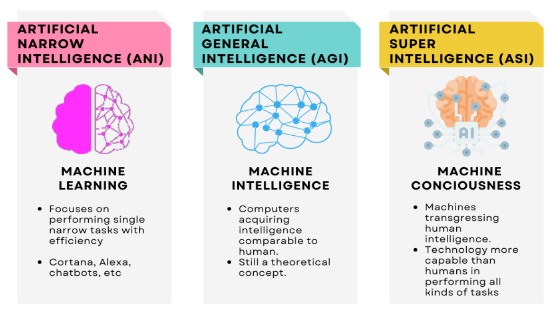
- Narrow AI is a goal-
oriented AI trained to perform a specific task. The machine intelligence that we witness all around us today is a form of narrow AI. Examples of narrow AI include Apple’s Siri and IBM’s Watson supercomputer.
Narrow AI is also referred to as weak AI as it operates within a limited and pre-
- General AI is an AI version that performs any intellectual task with a human-
like efficiency. The objective of general AI is to design a system capable of thinking for itself just like humans do. Currently, general AI is still under research, and efforts are being made to develop machines that have enhanced cognitive capabilities. - Super AI is the AI version that surpasses human intelligence and can perform any task better than a human. Capabilities of a machine with super AI include thinking, reasoning, solving a puzzle, making judgments, learning, and communicating on its own. Today, super AI is a hypothetical concept but represents the future of AI.

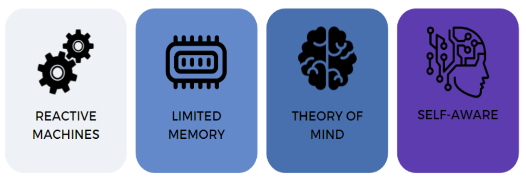
- Reactive machines are basic AI types that do not store past experiences or memories for future actions. Such systems zero in on current scenarios and react to them based on the best possible action. Popular examples of reactive machines include IBM’s Deep Blue system and Google’s AlphaGo.
- Limited memory machines can store and use past experiences or data for a short period of time. For example, a self-
driving car can store the speeds of vehicles in its vicinity, their respective distances, speed limits, and other relevant information for it to navigate through the traffic. - Theory of mind refers to the type of AI that can understand human emotions and beliefs and socially interact like humans. This AI type has not yet been developed but is in contention for the future.
- Self-
aware AI deals with super- intelligent machines with their consciousness, sentiments, emotions, and beliefs. Such systems are expected to be smarter than a human mind and may outperform us in assigned tasks. Self- aware AI is still a distant reality, but efforts are being made in this direction.

AI is primarily achieved by reverse-


AI research is focused on developing efficient problem-
The problem-

AI research revolves around the idea of knowledge representation and knowledge engineering. It relates to the representation of ‘what is known’ to machines with the ontology for a set of objects, relations, and concepts.
The representation reveals real-

Intelligent agents provide a way to envision the future. AI-
With the help of AI, we can make future predictions and ascertain the consequences of our actions. Planning is relevant across robotics, autonomous systems, cognitive assistants, and cybersecurity.

Learning is fundamental to AI solutions. Conceptually, learning implies the ability of computer algorithms to improve the knowledge of an AI program through observations and past experiences. Technically, AI programs process a collection of input-
AI primarily uses two learning models–supervised and unsupervised–where the main distinction lies in using labeled datasets. As AI systems learn independently, they require minimal or no human intervention. For example, ML defines an automated learning process.

Affective computing, also called ’emotion AI,’ is the branch of AI that recognizes, interprets, and simulates human experiences, feelings, and emotions. With affective computing, computers can read facial expressions, body language, and voice tones to allow AI systems to interact and socialize at the human level. Thus, research efforts are inclined toward amplifying the social intelligence of machines.

AI promotes creativity and artificial thinking that can help humans accomplish tasks better. AI can churn through vast volumes of data, consider options and alternatives, and develop creative paths or opportunities for us to progress.
It also offers a platform to augment and strengthen creativity, as AI can develop many novel ideas and concepts that can inspire and boost the overall creative process. For example, an AI system can provide multiple interior design options for a 3D-

AI researchers aim to develop machines with general AI capabilities that combine all the cognitive skills of humans and perform tasks with better proficiency than us. This can boost overall productivity as tasks would be performed with greater efficiency and free humans from risky tasks such as defusing bombs.

One of the critical goals of AI is to develop a synergy between AI and humans to enable them to work together and enhance each other’s capabilities rather than depend on just one system.


There’s no doubt in the fact that technology has made our life better. From music recommendations, map directions, and mobile banking to fraud prevention, AI and other technologies have taken over. There’s a fine line between advancement and destruction. There are always two sides to a coin, and that is the case with AI as well.
- Reduction in human error
- Available 24×7
- Helps in repetitive work
- Digital assistance
- Faster decisions
- Rational Decision Maker
- Medical applications
- Improves Security
- Efficient Communication
With all the advantages listed, it can seem like a no-
- Costly implementation
- Lack of emotion and creativity
- Degradation
- No improvement with experience
- Reduced jobs for humans
- Ethical problems

In order to select the best RPA tool, we need to keep in mind, the objectives and requirements of the company. Therefore, the following provides the necessary guidelines for choosing the right RPA tool.
- Ease of Implementation: One of the best features of RPA technology is its ease of implementation, non-
invasiveness, and compatibility with existing legacy systems. So, for choosing the right tool its necessary to check the integration capability with the existing systems to avoid downtime and enable smooth transition after implementing the automation solution. - Ease of use: The tool should be chosen in such a way that it is easy to work on, flexible enough to accommodate basic automation processes, require less training, user-
friendly and can be controlled easily. Moreover, the choice should be appropriate for business analysts who lack knowledge in programming. - Speed: Increasing process speed is probably one of the most important criteria. The main reason for introducing the RPA tool is to increase the speed and efficiency of the process. Therefore, we should check whether the respective RPA tool increases speed in the form of fast completion of tasks, quick mapping processes and more.
- Technical Features: There are some important technical features that the company should look at such as screen scraping, scalability, cognitive capabilities, and others. Since the software robots handle private data, the company should also check the security features of the tool. Essential security measures are therefore necessary, and the company should also ensure the extent of security they prefer before choosing an RPA tool. Otherwise, the system may become vulnerable to external malicious attacks, misuse of confidential data, privacy issues and others.
- Ownership Cost: The total cost of ownership is another important aspect that should be evaluated before choosing any RPA tool. It depends on various factors such as vendor fees, respective license fees, cost of implementation, maintenance and more. Any company would like to start small and then scale, hence the evaluation of the cost of RPA tool with the company’s RPA roadmap in mind is absolutely necessary
- Scalability: One of the important aspects of scalability is the support for large numbers of RPA robots working together to carry out many instances of a process. Another factor is expanding the scope of usage by providing consistent support for broadening how and where the solution is used in an organization. Companies should also look for expanded accessibility in an RPA tool. The tool should be able to easily integrate with new technologies.
- Architecture: A well designed RPA tool has huge implications in any company. It gives an idea regarding where and when we can use the respective RPA tool and how well it can be adapted for performing various tasks. Therefore, before choosing an appropriate RPA tool, we should make sure we have the right skills and expertise to make use of the tool as well as knowledge regarding where it should not be used. If the chosen RPA tool suits the requirements rightly, then any complex design and processes can be automated to become efficient and effective.
- Exception handling: The RPA tool of your choice should have a well-
designed exception handling process. It should detect errors during automation more quickly than manual detection. In some cases, errors require human attention and therefore need to be directed towards experts. However, if no attention is required then those errors should be handled automatically. If your process is prone to more errors, then it is advisable to choose an RPA tool with good exception handling techniques.



- Computer Network
- Data Recovery Services
- IT Business and Services
- IT Support Services
- On Site Support
- Remote Desktop Assistance
- Cloud Computing
- Information Security
Infrastructure-
- Physical machines,
- Virtual machines,
- Virtual storage, etc.
Platform-
- Applications,
- Development,
- Deployment tools, etc.
Software-
- Software applications as a service to end-
users. - Customer relationship management (CRM)
- Enterprise resource planning (ERP)
- Accounting software
- Human capital management (HCM) and human resources
- Project management
- Collaboration software
Cloud Computing Value Proposition
- IT management simplification
- Operation and maintenance cost reduction
- Business mode innovation
- Low cost outsourcing hosting
- High service quality outsourcing hosting
All Trademarks and Registered Trademarks are the property of their respective Owners.
2005 – 2024 Darwin & Associates IT, All rights Reserved

AI by Industry
Cloud AI Companies
Health Care AI Companies
Vehicle & Transportation AI Companies
Security AI Companies
E-
Financial AI Companies
Education AI Companies
Manufacturing & Engineering AI Companies
Energy & Environment AI Companies
Robotics AI Companies
Entertainment AI Companies
Robotic Process Automation Companies
- UiPath
- Automation Anywhere
- EdgeVerve
- SS&C Blue Prism
- WorkFusion
- Nice RPA
- ServiceNow
- AutomationEdge
- Pega systems
- Mulesoft RPA
| IT Services Repairs |
| IT Services Maintenance |
| Cloud Computing Security |
| AI and RPA |
| Cyber Security & Data Protect |